
A 24-hour monitor can reveal information that home readings cannot. But for many patients, a carefully collected week of home measurements is more comfortable, repeatable and representative of ordinary life.
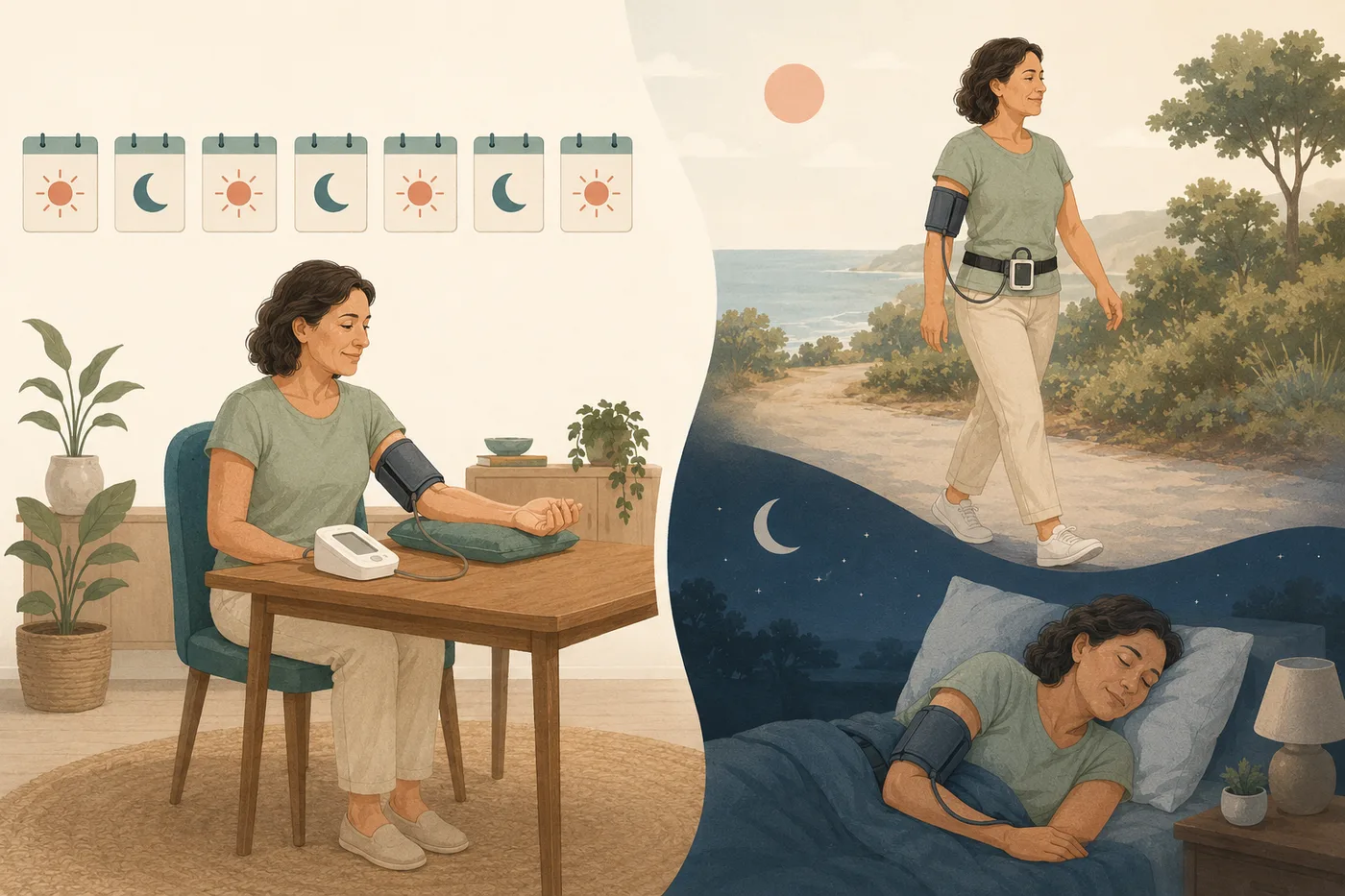
Blood pressure is not a fixed number. It changes with movement, work, meals, medication, pain, stress and sleep. That is why a single reading in a clinic is rarely enough to understand a person's usual blood pressure.
There are two common ways to measure blood pressure outside the clinic:
- Ambulatory blood pressure monitoring (ABPM): a cuff is worn for about 24 hours and inflates automatically at regular intervals during the day and night.
- Home blood pressure monitoring (HBPM): the person takes their own readings at planned times, usually morning and evening, over several days.
Both methods are useful, but they answer somewhat different questions. In my practice, I often prefer structured home monitoring for routine assessment and long-term follow-up — particularly when a 24-hour monitor is uncomfortable, disrupts sleep or changes the patient's normal day.
A 24-hour monitor should not be dismissed, but neither should one recording be treated as unquestionable truth. The best method is the one that answers the clinical question while producing reliable readings under reasonably normal conditions.
Can the measurement change what it is trying to measure?
The idea behind ABPM is excellent: measure blood pressure away from the clinic, during a normal day and during sleep. The practical difficulty is that wearing the monitor is not always a normal experience.
Depending on the device and protocol, the cuff may inflate every 15–30 minutes during the day and every 30–60 minutes overnight. Some people tolerate this well. Others find the repeated squeezing painful or distracting, become anxious while waiting for the next inflation, alter their activities, or wake repeatedly during the night.
This matters because blood pressure normally falls during sleep. If the monitor causes arousal, discomfort or a poor night's sleep, it is reasonable to ask whether the recorded night-time pressure reflects the patient's usual sleep — or the unusual night created by the test.
What does the research show?
The honest scientific answer is that the evidence is mixed.
In the BP-CHECK study of 510 adults, home monitoring was the most acceptable measurement method and ABPM the least acceptable. Sleep disturbance, interference with work and discomfort accounted for much of the difference.[1] In a separate analysis from the same research program, average home systolic pressure was very close to average daytime ambulatory pressure.[2]
Some studies suggest that ABPM can disturb sleep and may affect the measurements in susceptible people:
- In 203 untreated patients who underwent two ambulatory recordings, monitoring disturbed sleep. When sleep quality was worse on the second recording, night-time blood pressure was higher and the normal overnight fall in pressure was smaller.[3]
- In 192 relatively healthy adults monitored with wrist actigraphy over seven nights, wakefulness and sleep fragmentation were greater and sleep efficiency was lower on the ABPM night. The study did not determine whether this disturbance changed the recorded sleeping blood pressure.[4]
Other studies have found little or no meaningful effect:
- In 121 people with untreated hypertension, actigraphy showed no reduction in sleep efficiency or total sleep time during three nights of ABPM compared with seven nights without it.[5]
- A small 21-person pilot found no significant effect of cuff inflations on mean sleeping pressure or sleep efficiency. However, it analysed estimates from a cuffless device rather than the cuff readings themselves, which limits how confidently the result can be generalised.[6]
- A randomised sleep-laboratory study using full polysomnography in 10 adults found no significant worsening of total sleep time, sleep efficiency or awakenings during the ABPM night.[7]
These findings do not support the broad claim that ambulatory monitoring always raises blood pressure artificially or makes the result invalid. They support a more careful conclusion: the effect varies between individuals, and a visibly disturbed night should be considered when the result is interpreted.
Why ABPM remains important
ABPM remains an important reference method. It records blood pressure during sleep, can identify nocturnal hypertension and abnormal overnight dipping, and has a larger body of evidence linking ambulatory measurements with cardiovascular outcomes. Current guidelines therefore continue to give ABPM a central role, while also recognising properly performed home monitoring as an accepted way to confirm hypertension.[8,9]
The concern is not that ABPM is an invalid test. It is that a single recording may be less representative in a patient whose sleep, activity or stress level was substantially altered by wearing it.
Why home monitoring is often more useful in everyday care
ABPM provides many readings, but it usually samples only one day and one night. Home monitoring samples fewer moments each day, but can do so across five to seven days — and can be repeated later when treatment is being adjusted.
That longer view has practical advantages:
- It captures more than one type of day. Work, sleep, exercise, stress and medication timing can vary from day to day.
- It is easier to repeat. A home series can be collected again after a medication change or at intervals agreed with the treating clinician.
- It is usually better tolerated. The patient chooses a quiet time, rests, and measures without wearing a cuff continuously.
- It supports ongoing care. A dated record can reveal patterns and can be reviewed with a GP or specialist rather than relying on memory or isolated readings.
- It involves the patient. When used according to a clear plan — not compulsively — home monitoring can help people understand their blood pressure and participate in treatment decisions.
The 2025 AHA/ACC guideline recommends either ABPM or HBPM to confirm suspected hypertension. It also recommends HBPM, together with clinical support, for monitoring treatment and medication titration.[9]
Home monitoring and 24-hour monitoring are not interchangeable
| Question | Structured home monitoring | 24-hour ambulatory monitoring |
|---|---|---|
| What does it sample? | Planned readings over several days | Frequent readings across one day and night |
| Comfort and convenience | Usually better tolerated and easy to repeat | Can be uncomfortable and may disturb work or sleep |
| Night-time blood pressure | Usually not measured during sleep | Measures sleeping pressure and overnight dipping |
| Long-term follow-up | Well suited to repeated review | Usually too burdensome for frequent use |
| Main reliability issue | Device choice, cuff size, technique and incomplete recording | Movement, failed readings, an atypical day or disturbed sleep |
| Particularly useful for | Routine follow-up, treatment response, and morning and evening patterns | Nocturnal hypertension, dipping pattern and selected resistant or masked hypertension questions |
Home monitoring also has limitations. It depends on a validated device, the correct cuff size, good technique and a complete record. It can increase anxiety if someone measures too frequently or reacts to every individual number. Most home devices do not measure blood pressure during sleep.
This is why home monitoring is not simply "better" than ABPM in every situation. It is often the more practical tool for a repeated real-world picture, while ABPM provides unique information when the night-time pattern is clinically important.
How to collect a useful home blood pressure series
A commonly used Australian protocol is:
- Use a validated automatic upper-arm monitor with the correct cuff size.
- Avoid caffeine, smoking and vigorous exercise for 30 minutes beforehand.
- Sit quietly for five minutes, with your back supported, feet flat on the floor, legs uncrossed and arm supported at heart level.
- Take two readings, one minute apart, in the morning and again in the evening.
- Continue for seven days, or for at least five days if advised by your clinician.
- Record every reading, even if one seems unusually high or low. A dated digital diary such as Health Diary can make the complete series easier to organise and share.
- Under the Australian seven-day protocol, the first day's readings are recorded but excluded when the average is calculated.[10,11]
Under the traditional clinic threshold of 140/90 mmHg, the corresponding home average is approximately 135/85 mmHg. Thresholds and treatment targets can vary with the guideline, the patient's health and the reason for monitoring, so the average should be interpreted by a clinician rather than used to change medication independently.[9,10]
Smartwatches and other cuffless devices may be convenient, but current evidence is not sufficient for them to replace a validated upper-arm cuff when diagnosing or managing hypertension.[9]
When I would still use a 24-hour monitor
ABPM can add information that ordinary home monitoring cannot provide. I would still consider it when:
- night-time hypertension or an abnormal overnight dipping pattern is suspected;
- sleep apnoea, kidney disease, diabetes or another condition makes nocturnal pressure particularly relevant;
- apparently resistant hypertension needs to be distinguished from a white-coat effect or another misleading pattern;
- clinic and properly collected home readings remain markedly inconsistent;
- symptoms or suspected low blood pressure occur at unpredictable times;
- home measurement is not feasible or the technique and record cannot be made reliable; or
- a borderline or discordant result — particularly in a younger patient — would materially affect a decision about long-term treatment.
Even then, the recording should be interpreted in context. Did the person sleep reasonably well? Was the day typical? Were there enough valid readings? Did the cuff cause significant pain or anxiety? A technically complete report is not automatically a physiologically typical day.
The bottom line
For many patients, a well-performed series of home blood pressure readings offers a sensible balance of accuracy, comfort and repeatability. It measures blood pressure in a familiar setting and allows us to examine a pattern across several days rather than placing too much weight on one clinic reading — or one unusual 24-hour period.
ABPM remains valuable, particularly when we need to know what happens during sleep. But it is a tool, not a perfect truth machine. If the monitor substantially changes sleep, activity or stress, that context belongs in the interpretation.
The goal is not to choose one method for everyone. It is to choose the method that gives the most trustworthy answer for the individual patient.
Track the pattern, not a single number
Health Diary helps you keep a dated record of home blood pressure readings so you can review the pattern and share it with your doctor. It does not diagnose hypertension or replace medical care.
Sources
- Thompson MJ, et al. Acceptability and adherence to home, kiosk, and clinic blood pressure measurement compared with 24-hour ambulatory monitoring. Journal of General Internal Medicine. 2023;38:1854–1861.
- Green BB, et al. Clinic, home, and kiosk blood pressure measurements for diagnosing hypertension: a randomized diagnostic study. Journal of General Internal Medicine. 2022;37:2948–2956.
- Henskens LHG, et al. Subjective sleep disturbance increases the nocturnal blood pressure level and attenuates the correlation with target-organ damage. Journal of Hypertension. 2011;29:242–250.
- Gaffey AE, et al. Effects of ambulatory blood pressure monitoring on sleep in healthy, normotensive men and women. Blood Pressure Monitoring. 2021;26:93–101.
- Sherwood A, et al. The effects of ambulatory blood pressure monitoring on sleep quality in men and women with hypertension. American Journal of Hypertension. 2019;32:54–60.
- Socrates T, et al. Effect of cuff inflation on blood pressure, arousals, sleep efficiency, and desaturations. Diagnostics. 2023;13:2874.
- Bezerra AB, et al. Minimal changes in sleep parameters during overnight ambulatory blood pressure monitoring do not affect outcomes. Sleep and Breathing. 2025;29:15.
- McEvoy JW, et al. 2024 ESC Guidelines for the management of elevated blood pressure and hypertension. European Heart Journal. 2024;45:3912–4018.
- Jones DW, et al. 2025 AHA/ACC guideline for the prevention, detection, evaluation and management of high blood pressure in adults. Journal of the American College of Cardiology. 2025.
- Sharman JE, et al. Home blood pressure monitoring: Australian Expert Consensus Statement. Journal of Hypertension. 2015;33:1721–1728.
- Royal Australian College of General Practitioners. How to measure home blood pressure: recommendations for healthcare professionals and patients. Australian Family Physician. 2016;45:31–34.
This is general information and does not replace advice from your doctor or healthcare professional. Health Diary does not monitor your readings. If you feel unwell or a reading worries you, contact your doctor's rooms, or call 000 in an emergency.